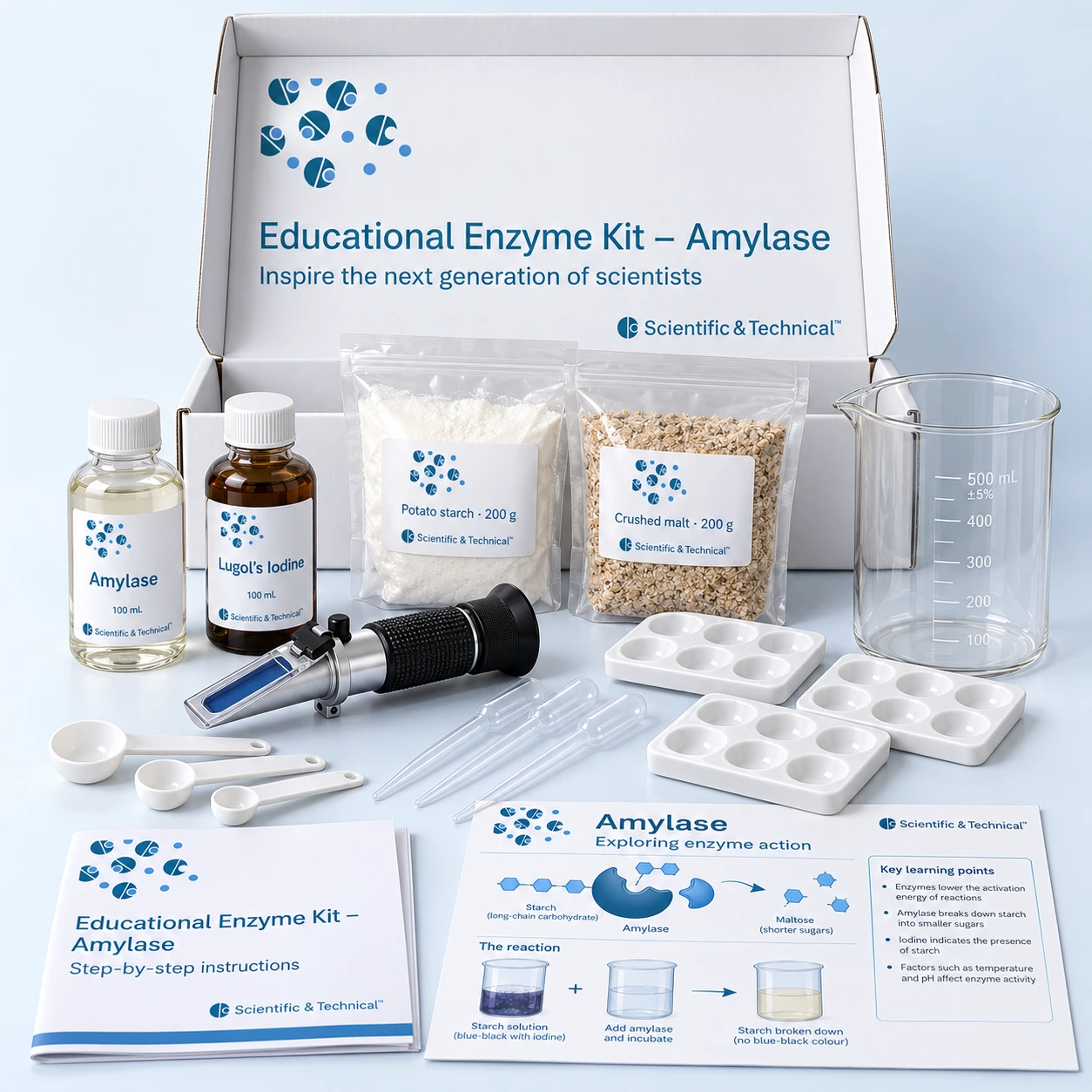
AMYLASE experiments
Follow starch breakdown and turn a colour change into evidence about enzyme activity.
Step-by-step class guide →Inspire students to ask why, test an idea and discover something for themselves. Real enzyme experiments for schools, colleges and universities—from a first colour change to an independent investigation.
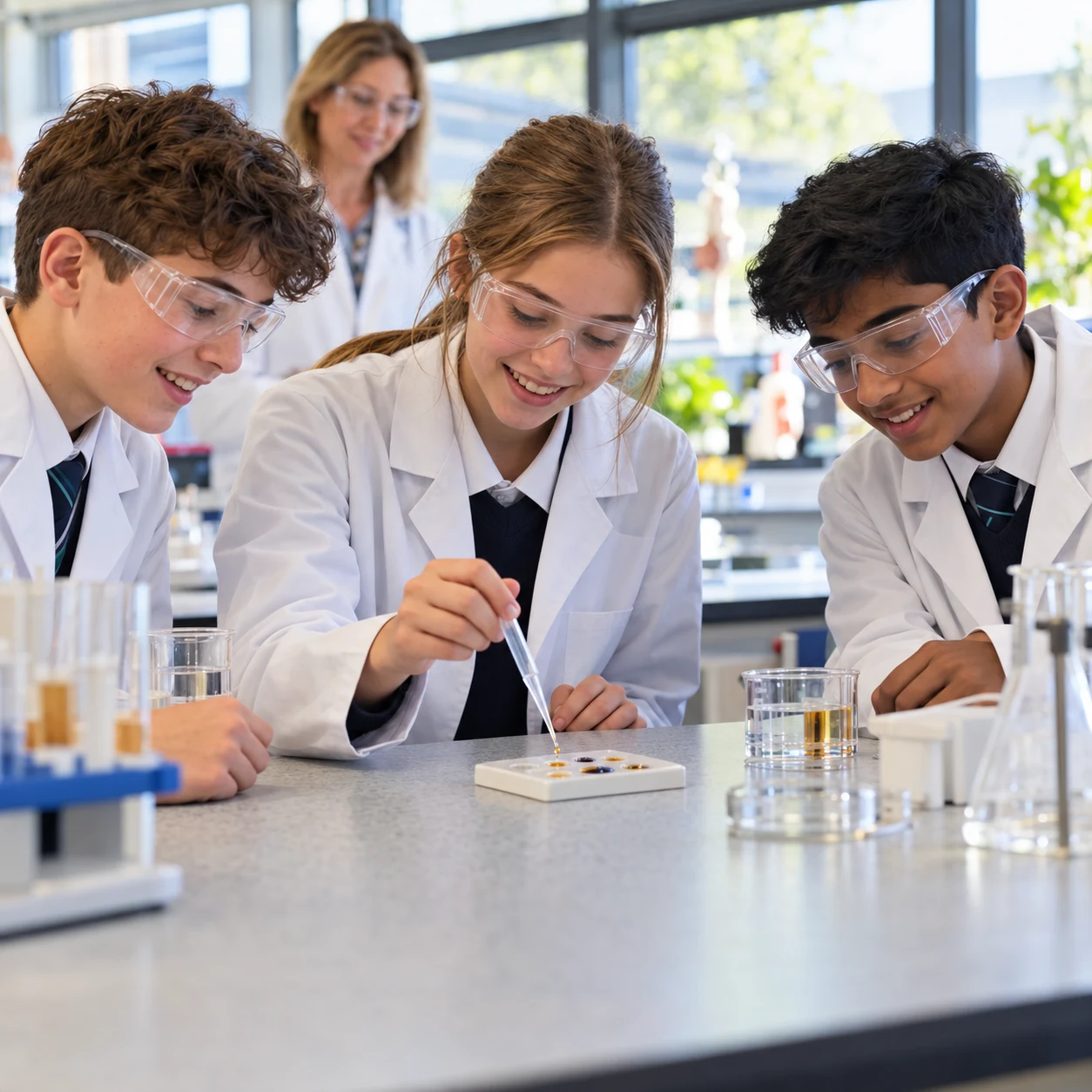
KS3 and GCSE investigations in digestion, specificity and reaction rates. Start with an observable change.
Explore school practicals ↗02 / COLLEGESA-level and further education: design controls, compare variables and make sense of your evidence.
Explore post-16 investigations ↗03 / UNIVERSITIESUndergraduate teaching, enzyme kinetics and project work, with individual enzymes and department enquiries.
Explore university supply ↗Explore familiar classroom practicals and more advanced investigations. Filter by teaching level or search for an enzyme, substrate or topic.
Core classroom choices sit alongside extended and advanced investigations. Suggested levels are a planning guide; the selected preparation, assay and institutional assessment determine suitability.
Follow starch breakdown and turn a colour change into evidence about enzyme activity.
Step-by-step class guide →Explore oxygen production and investigate the variables that affect reaction rate.
Step-by-step class guide →Connect enzyme specificity to lactose breakdown and a familiar food application.
Step-by-step class guide →Investigate fruit processing and compare juice recovery with and without an enzyme.
Step-by-step class guide →Make protein breakdown tangible and investigate substrate choice and conditions.
Step-by-step class guide →Investigate renewable plant materials and the challenges of converting biomass.
Step-by-step class guide →Investigate fat hydrolysis with a compatible pH readout, or compare removal of fatty stains.
Step-by-step class guide →Compare sucrose with its breakdown products using an appropriate glucose or reducing-sugar assay.
Step-by-step class guide →Explore a plant-derived protease using a suitable protein substrate and controlled conditions.
Step-by-step class guide →Explore glucose release from starch and compare a single enzyme with an enzyme combination.
Step-by-step class guide →Compare starch-processing enzymes and discuss how enzyme action changes the products formed.
Step-by-step class guide →Compare a defined xylan substrate or plant material with and without a hemicellulose-degrading enzyme.
Step-by-step class guide →Investigate cellobiose conversion and the complementary action of plant-processing enzymes.
Step-by-step class guide →Investigate inulin hydrolysis and connect plant carbohydrates to food biotechnology.
Step-by-step class guide →Explore starch branching and compare enzyme combinations in a planned carbohydrate investigation.
Step-by-step class guide →Explore enzyme-based sensing using a validated coupled assay and appropriate controls.
Step-by-step class guide →Investigate an oxidative enzyme using an appropriate chromogenic substrate and controlled assay.
Step-by-step class guide →Compare enzyme action, explore different substrates and connect the science across a series of practicals. Choose the focused trio or the broader seven-enzyme collection.
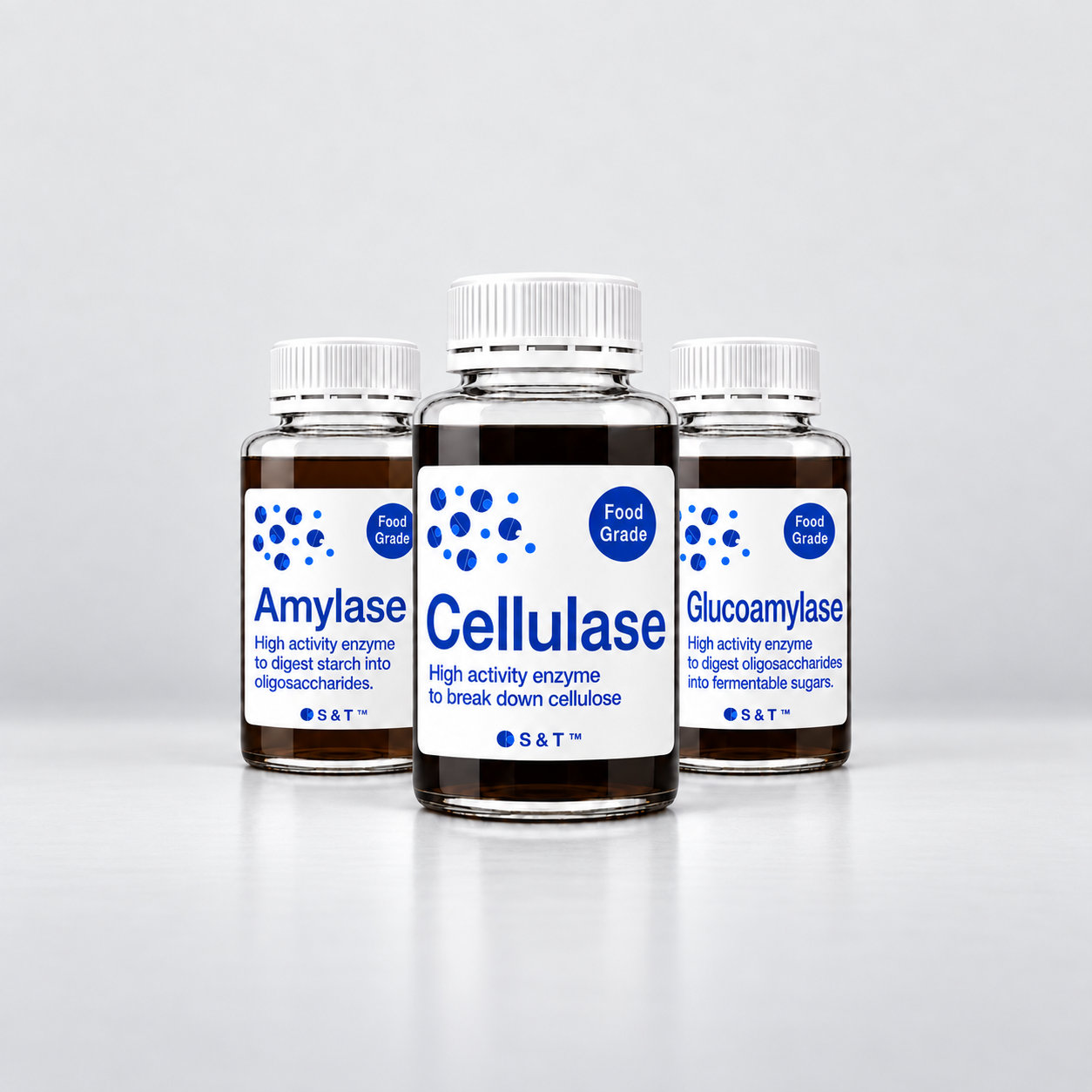
Explore carbohydrate breakdown with three complementary enzymes. A starting point for comparing starch, cellulose and sugar release.
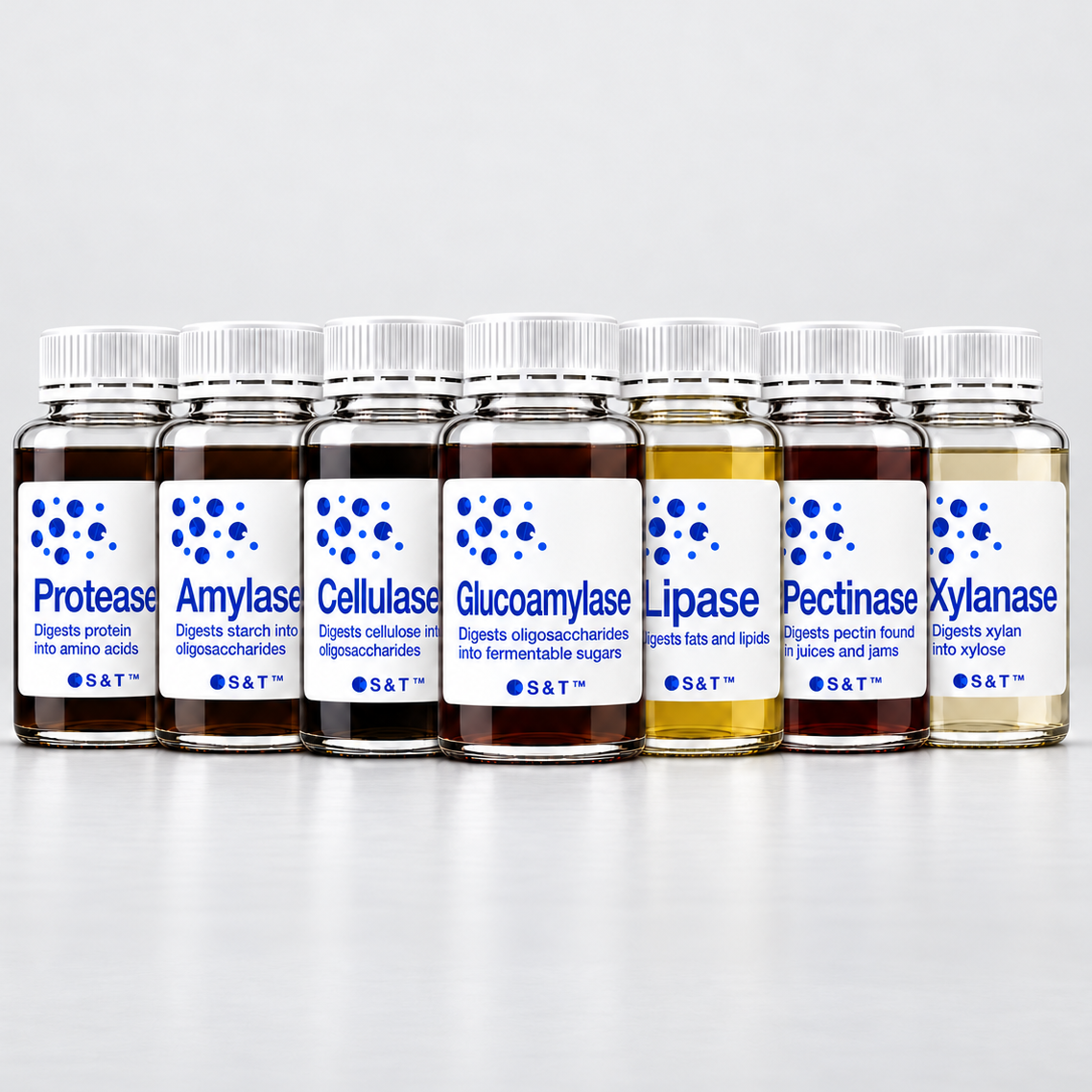
Broaden your practical programme across carbohydrates, proteins and fats. Compare enzyme specificity and explore real biotechnology applications.
These are enzyme collections. Supporting substrates, assays, equipment and teaching protocols should be planned separately. Check the product listing for final pack contents and sizes.
Bring starch digestion to the lab bench with the S&T Amylase Education Kit. See a colour change, measure with a refractometer and connect an everyday process to the science behind it.
Ages 11+ with competent adult supervision. A teacher or technician should review the instructions and required supporting equipment before use.
Download the illustrated kit guide (PDF) ↗
Catalogue price checked 18 October 2026. Current price, tax and delivery shown at S&T checkout.
One good question opens up variables, predictions, evidence and discussion.
Explore the amylase concept →A useful point to compare with cooler and hotter conditions.
Illustrative teaching model, not measured data or a specification for any enzyme preparation.
Less time piecing things together. More time helping students connect the practical to the science.
Teaching resources below are previews. Check the selected product’s instructions, SDS and storage guidance, and approve practicals through your institution’s risk assessment. The amylase education kit includes its own instructions and poster.
Explore all 17 enzyme guides: natural history, reaction chemistry, industrial applications, class methods, realistic timings and printable student sheets.
Long product shelf lives make it easier to plan ahead and get more from your department budget. Store correctly, prepare only what you need and keep the rest ready for the next investigation.
See what your supply could deliver →Examples from the S&T catalogue include catalase liquid (12 months) and lactase powder (24 months). Shelf life is product-specific and depends on the stated storage conditions.
Follow the product sheet and batch expiry. Concentrate shelf life does not establish the stability of a prepared dilution or every component in a kit. Ask us for remaining shelf life before ordering.
Ask about storage & shelf life ↗See how a bottle or kit stretches across working groups, repeat runs and classes. Adjust the figures to match your practical and build a transparent budget.
Choose your product or enter your own price.
02Set the amount of concentrate used per reaction.
03See cost per reaction, class and student.
One experiment means one reaction or test. A class investigation can include several tests, controls and repeats. Dose defaults are budgeting examples, not practical instructions.
Support undergraduate practicals and student projects with individual enzymes, a clear experimental question and room to investigate.
Discuss your teaching laboratory ↗Plan substrate series, initial-rate measurements and controls using a preparation and assay appropriate to your course.
Explore food processing, plant biomass and enzyme specificity through practical comparisons.
Ask about pack sizes, repeat teaching requirements, product documentation and a tailored department quotation.
Browse by teaching level and choose the science you want students to see.
Use the calculator, choose an enzyme or kit and prepare a department enquiry.
Order the education kit at S&T, or request a department quote and discuss purchase-order requirements.
Common starting points include amylase for starch digestion, catalase for oxygen production, protease for protein breakdown, lipase for fat hydrolysis and pectinase for fruit processing. Lactase and other preparations can support extended investigations. Suitability depends on the preparation, protocol and teaching context.
ProStar Enzyme Kit I contains amylase, cellulase and glucoamylase. It is an enzyme collection; supporting reagents, substrates and equipment should be planned separately.
ProStar Enzyme Kit II contains amylase, cellulase, glucoamylase, lipase, pectinase, protease and xylanase. Check the current product listing for the final pack contents and sizes.
Divide the pack price by the pack quantity and multiply by the concentrate used per test. Add other consumables, then multiply by your working groups, tests and repeats. The calculator also shows class costs, costs per student and the whole packs needed.
Schools can request 15% off through a discounted quotation from S&T. Confirm your discounted order before payment. International delivery is free on orders over £100.
Put more practical science into your budget. Tell us your school and the supplies you need when requesting your discounted quotation.
Request your school discount ↗Equip your teaching lab wherever you are. International orders below £100 carry a £30 delivery charge. Final charges and any applicable taxes or import charges are shown or confirmed when ordering.
Explore the enzyme kits ↗A single practical, a term of teaching or an idea you haven’t quite worked out. Tell us what you have in mind.