Amylase / Exploring enzyme action
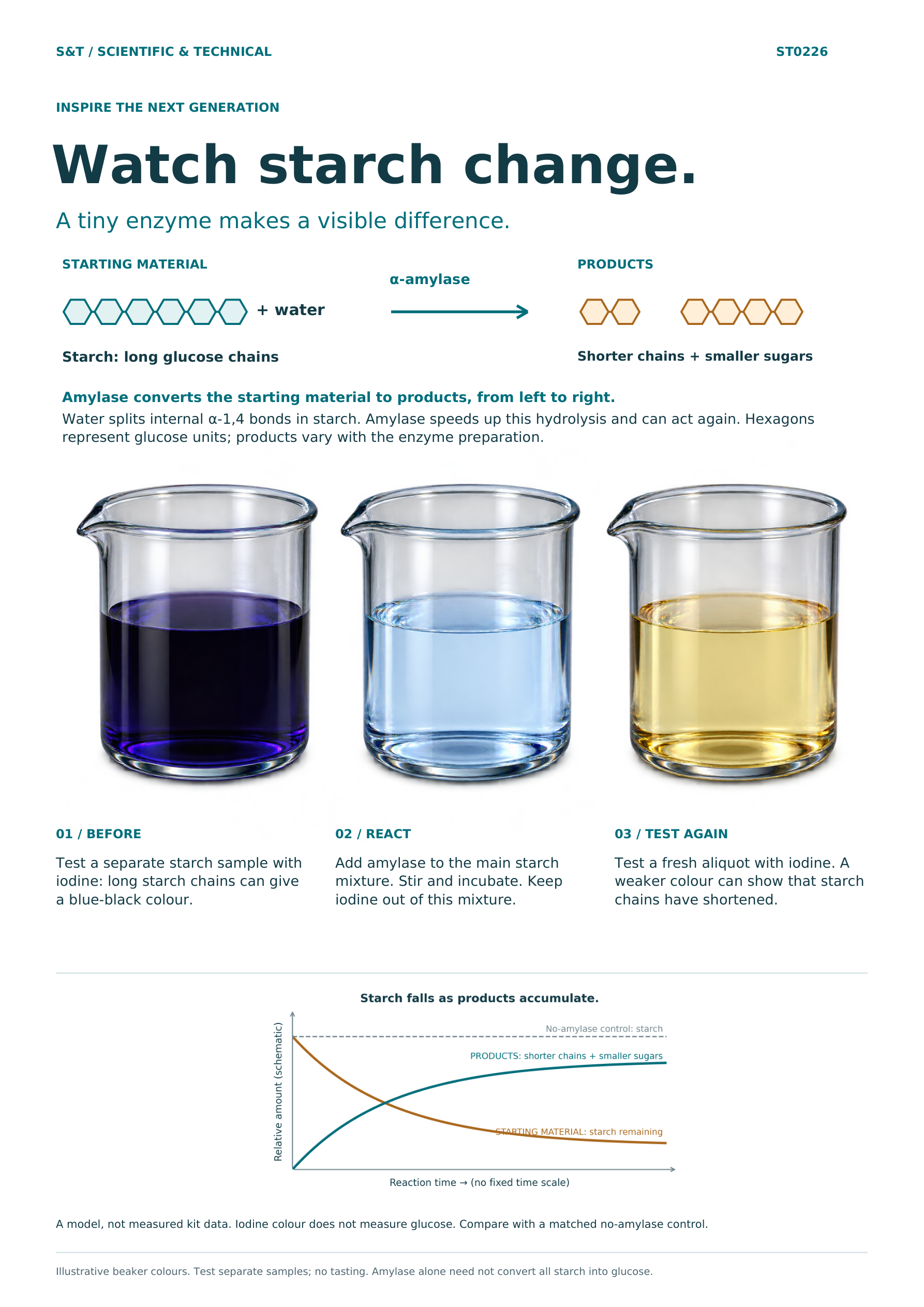
Tap the poster to open the full-resolution image. Download the sharp A4 poster PDF.
Amylase reaction profiles
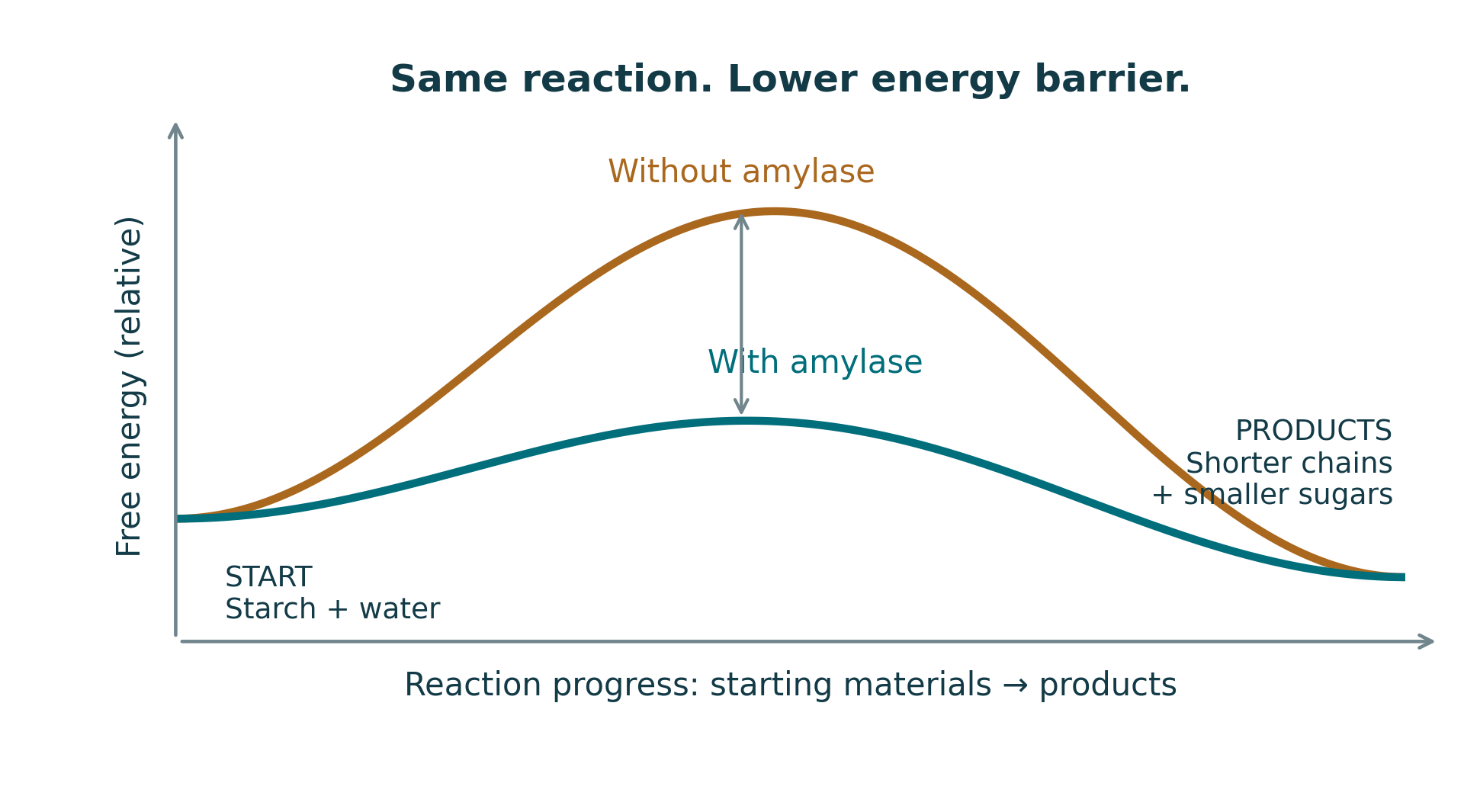
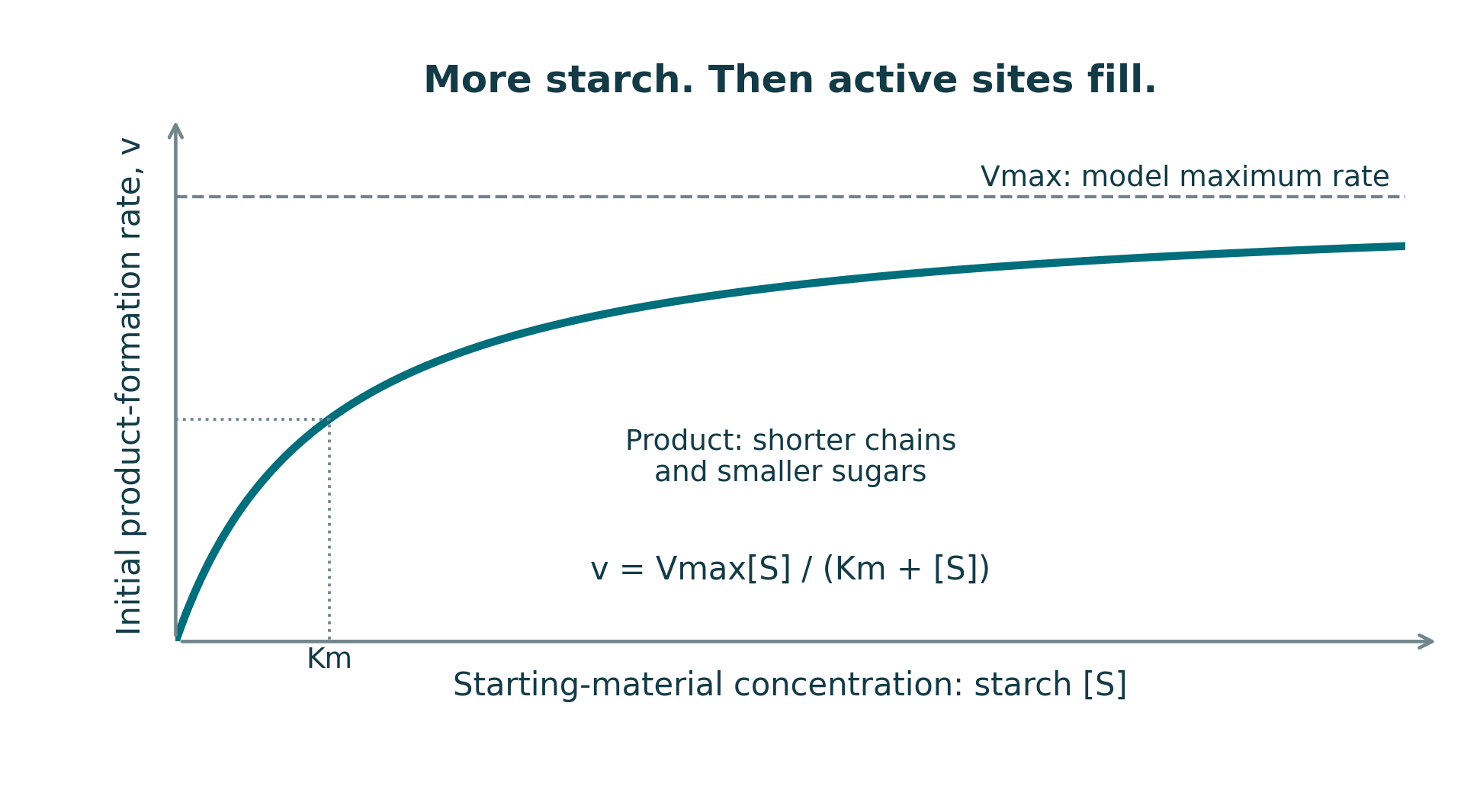
Amylase lowers the activation barrier. It does not change the overall reaction energy difference. At fixed active enzyme concentration, a simple saturation model approaches Vmax as substrate concentration rises. Starch is heterogeneous, so this model may not describe a real kit experiment.
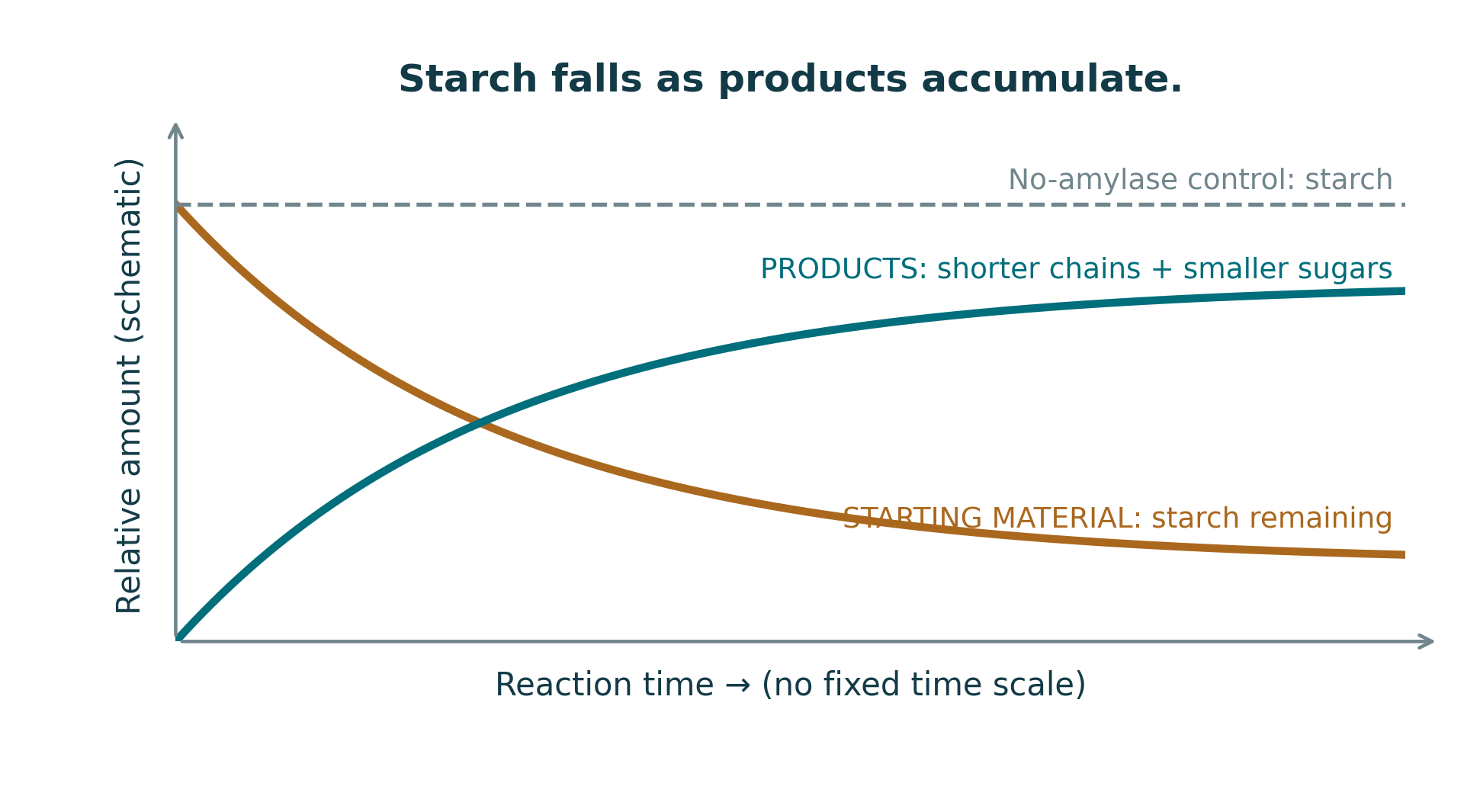
All curves are illustrative: no measured values, fixed times, Km, Vmax or guaranteed conversion. Use your own class observations. Iodine and Brix do not directly measure glucose or initial velocity.
IUPAC: catalyst · IUBMB: alpha-amylase reaction
Inside your kit. Before your class. 02 / CONTENTS AND PREPARATION
SUPPLIED ITEM QUANTITY
Amylase enzyme / Lugol’s iodine solution 100 mL of each
Potato starch / crushed malt 200 g of each
Portable refractometer / 500 mL beaker 1 of each
Measuring spoons / 3 mL Pasteur pipettes 3 of each
Six-well sampling trays 3
Step-by-step instructions / educational poster 1 guide and 1 A4 poster
Additional equipment to arrange A balance; timer; thermometer; adult-operated kettle; stirring rods; a calibrated pipette or syringe for measured enzyme additions; an additional matching heat-resistant beaker for the parallel control; water-bath equipment if used; PPE; distilled water for the refractometer; and the materials needed by your local disposal procedure.
A short reaction is not a whole lesson Plan 25-40 minutes for a demonstration, including prepared materials, observations and discussion. The reaction observation window targets 5-10 minutes after a teacher pilot. Preparing and cooling a starch paste takes additional time. One kit includes one beaker and one refractometer; it is not a complete 10-station equipment set.
Safety and handling • Competent adult supervision throughout. The teacher completes the institutional risk assessment and reviews current SDS before use.
• Only an adult handles boiling water and hot paste. Cool mixtures to the pilot-selected working temperature before enzyme addition.
• Wear eye protection, suitable gloves and a lab coat. Avoid enzyme mist, splashes and dust; pupils receive prepared liquids. No tasting.
• Use iodine at the confirmed working strength. Follow local iodine-containing and enzyme-waste disposal rules; do not assign waste streams from this guide alone.
The story behind the reaction 01 / NATURE, CHEMISTRY AND INDUSTRY
A way to unlock stored food Plants store energy in starch. Germinating seeds use enzymes to mobilise those reserves, while animal digestive systems use amylases to begin breaking dietary starch into smaller carbohydrates. Microorganisms also produce amylases. Commercial preparations can differ in their source, activity and temperature response.
What does amylase actually do?
Starch + water → shorter dextrins and smaller carbohydrates
Alpha-amylase cleaves internal alpha-1,4 glycosidic bonds in starch. It can rapidly reduce the length of the starch chains and the viscosity of a paste. The exact products depend on the preparation. Amylase alone does not necessarily convert all starch into glucose.
+ amylase →
Schematic chain fragments, not a chemical structure or a measured product distribution.
The same chemistry, useful applications
APPLICATION WHY THE ENZYME IS USEFUL
Brewing and baking Helps make starch-derived carbohydrates available for further processing.
Starch and syrup processing Liquefies starch; complementary enzymes can drive conversion towards particular sugars.
Cleaning Suitable detergent amylases help remove starch-based soils.
Biofuels Supports feedstock conversion as one stage of a broader process.
Three observations, three different meanings Iodine colour reports the presence of suitable starch chains. Viscosity describes how the mixture flows. °Brix is a refractive-index reading expressed on a sucrose-equivalent scale; in these mixed samples it is an approximate soluble-solids indication, not a glucose-specific assay.
Experiment 1 / Potato starch 03 / A VISIBLE CHANGE IN A STARCH PASTE
Question: Does amylase change a starch paste faster than an otherwise matched mixture without enzyme?
Per reaction: 10 g potato starch + 20 mL cold water + 150 mL hot water. Prepare one ENZYME reaction and one CONTROL: total 20 g starch and 340 mL water, in separate 500 mL heat-resistant beakers.
- An adult weighs 10 g starch into each beaker. Add 20 mL cold water to each and stir into a smooth slurry.
- An adult adds 150 mL freshly boiled water to each and stirs for 2 minutes to gelatinise the starch. Keep preparation and stirring identical.
- Cool both mixtures to the same teacher-selected working temperature, initially 50°C for a pilot, only if compatible with the supplied enzyme. Record the actual temperature and pH.
- Take the time-zero samples before enzyme addition. Use separate trays for ENZYME and CONTROL. Make any baseline refractometer reading from an iodine-free sample cooled to the instrument’s permitted temperature.
- For the technician pilot, start with 0.5 mL supplied liquid enzyme in ENZYME and 0.5 mL water in CONTROL. This is a proposed measured trial dose, not a validated replacement for the old “three drops”. Mix identically and start timing.
- At 2, 4, 6, 8 and 10 minutes, place 1 mL from each mixture into the matching labelled well. Add 3 drops of the confirmed working iodine reagent to each well and record the colour.
- Observe changes in flow or stirring resistance without changing the stirring conditions between beakers. For °Brix, use separate iodine-free aliquots, cool them and follow page 6.
- Compare the paired time courses. If the enzyme reaction finishes immediately, dilute or reduce the dose before class; if it is too slow, check activity, mixing, pH and temperature before increasing the dose.
Teacher pilot: The original document used a drop-based addition with no measured drop volume. Record the final dose, batch and conditions you establish; do not present a fixed colour sequence or °Brix increase as guaranteed.
Experiment 2 / Crushed malt 04 / CONNECT ENZYMES TO BREWING AND GRAINS
Question: Does added amylase change a prepared malt mixture compared with a matched no-added-enzyme control?
Per reaction: 20 g crushed malt + 200 mL hot water. Prepare ENZYME and CONTROL from the same malt batch: total 40 g malt and 400 mL water. Natural malt sugars and other soluble material affect the baseline.
- An adult weighs 20 g well-mixed crushed malt into each of two matching 500 mL heat-resistant beakers.
- An adult adds 200 mL freshly boiled water to each and stirs for 2 minutes. Treat both portions identically; hot-water preparation can alter the malt’s own enzyme activities.
- Cool both mixtures to the same pilot-selected working temperature, initially 50°C if the current enzyme guidance supports it. Record temperature and pH.
- Take a representative time-zero sample from each, using equal stirring before sampling. Keep solids handling and sampling depth consistent.
- For a technician pilot, add 0.5 mL supplied amylase to ENZYME and 0.5 mL water to CONTROL. Mix identically and start timing. Tune this proposed dose before class.
- At 2, 4, 6, 8 and 10 minutes, transfer 1 mL samples into separate labelled trays. Add 3 drops of the confirmed working iodine reagent to each sample and record the appearance.
- For the refractometer, take a fresh iodine-free aliquot. Use the same settling or clarification procedure for every sample, cool to the permitted measurement temperature and record °Brix.
- Compare changes against each mixture’s own baseline and the no-added-enzyme control. Discuss how grain particles, extraction and existing sugars complicate the result.
Interpret carefully: Malt already contains sugars and may retain some native activity. This comparison asks about the effect of added enzyme. A cloudy, coloured malt sample is not equivalent to a clear sucrose solution.
Sample consistently. Read carefully. 05 / SIX WELLS, SIX TIME POINTS
Use one six-well tray for each condition. The time-zero well is a baseline sample, not a substitute for the parallel no-enzyme control. Label the two trays clearly.
A1 / 0 min A2 / 2 min A3 / 4 min
B1 / 6 min B2 / 8 min B3 / 10 min
Iodine: observe starch-chain breakdown Use the same sample volume and iodine amount at every time point. The archived method specified 1% Lugol’s iodine; confirm the actual bottle concentration and current handling guidance. A technician prepares a suitable working reagent when required. A dark blue-black response indicates iodine-binding starch structures; a weaker response can accompany chain shortening.
Refractometer: keep the iodine out
- Calibrate with distilled water according to the instrument instructions.
- Take a separate aliquot before adding iodine; never put an iodine-treated sample on the prism.
- Cool the aliquot to the instrument’s specified range. Temperature compensation is not permission to place hot liquid on the prism.
- Apply enough sample to cover the measurement area, close the cover if required and read °Brix. Keep settling or clarification consistent.
- Clean the prism between samples as instructed; use the same instrument and reading procedure for the full comparison.
What can you conclude? An enzyme-specific change relative to the control supports an effect of added amylase. Neither iodine colour nor °Brix alone measures glucose yield or proves complete starch conversion. The old guide’s “about 2 to 5 °Brix” example is not a required result and is not used as a performance claim here.
Student record / Your evidence
Name: ____________________ Group: ______ Date: __________
Substrate: ____________________ Enzyme batch: ____________
Dose / dilution: __________ Temperature: ______ °C pH: ______
Prediction:
If measuring both conditions every two minutes is impractical, prioritise paired iodine readings and record °Brix at baseline and 10 minutes. Mark unmeasured cells with a dash.
Think like a scientist
- Which observation differed from the control, and when?
- Why does the control need the same temperature, water addition and stirring?
- Why is °Brix not glucose-specific here?
- What limitation would you improve?
Conclusion:
Teacher planning & next questions 07 / MAKE THE PRACTICAL WORK FOR YOUR CLASS
Pilot once. Record the conditions. Use the actual kit enzyme, substrate batch and iodine reagent before class. Aim for a useful 5-10 minute observation window. If a high dose makes the result immediate, reduce or dilute it. If the reaction is slow, check preparation, temperature, pH, mixing and activity first. A higher dose cannot correct an unsuitable assay.
Scale the materials, not the concentrations
MATCHED PAIRS STARCH REQUIRED MALT REQUIRED
- enzyme + 1 control 20 g starch; 340 mL water 40 g malt; 400 mL water
- matched pairs 100 g starch; 1.7 L water 200 g malt; 2 L water
10 matched pairs 200 g starch; 3.4 L water 400 g malt; 4 L water
These are alternative substrate sessions, before preparation losses. The kit’s 200 g malt is insufficient for ten full-size malt pairs. Each pair also needs two beakers and two sampling trays; the kit contains one beaker and three trays. Share equipment as a demonstration or arrange additional apparatus. Use the website calculator with the final measured enzyme dose.
Useful extensions Change one variable at a time: enzyme dose, temperature or substrate loading. Repeat the paired comparison and discuss uncertainty. Investigate the difference between a fast iodine endpoint and the amount or identity of sugars produced. Fermentation is a separate, longer practical requiring its own protocol; a 6-12 hour alcohol yield is not promised.
Sources and revision notes Reworked from the S&T; Educational Kit - Amylase instructions (2024). Current product reference: ST0226. This edition updates contact details and sampling labels, corrects the interpretation of °Brix, adds a parallel control, and separates archived recipes from proposed measured-dose pilot conditions.
Further reading: Bell et al., Biocatalysis, Nature Reviews Methods Primers 1, 46 (2021); Practical Biology enzyme-activity methods; current product label, technical sheet and SDS.
Class experiment library · Teacher resources & calculators S&T; amylase education kit sales@scientificandtechnical.com · www.scientificandtechnical.com
Amylase: tiny enzyme, big possibilities
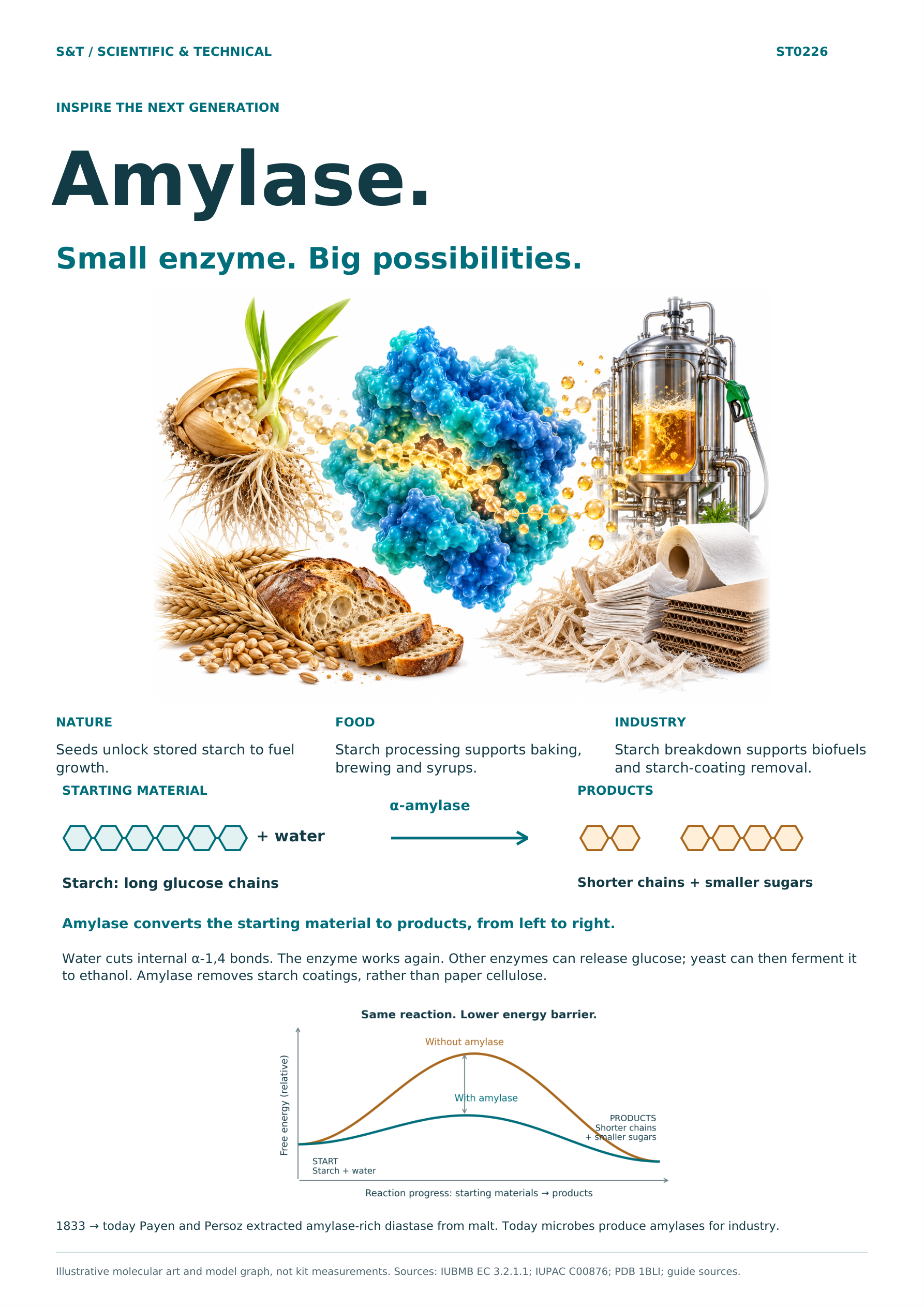
A3 classroom poster PDF · A4 print edition
Amylase uses water to cut internal α-1,4 links in starch. Its folded active site speeds up the reaction. Temperature and pH affect activity. In 1833 Payen and Persoz extracted an amylase-rich diastase preparation from malt. Today amylases help process food and starch, remove some starch-based paper coatings during recycling, and prepare starch for bioethanol production alongside other enzymes and yeast.
The blue protein artwork is illustrative and does not identify the kit enzyme. A representative bacterial α-amylase structure is available as PDB 1BLI. Amylase acts on starch, not paper cellulose or ordinary plastic, and does not make ethanol by itself.
Poster sources and further reading
Teacher answer key
1. Which observation differed from the control, and when?
Use the pupils’ recorded results. A supported answer identifies the actual time and describes a difference in iodine colour, flow or soluble-solids reading relative to the matched control. If no reliable difference was recorded, state that honestly; no fixed colour sequence, endpoint or °Brix rise is required.
2. Why must temperature, water addition and stirring match?
They are controlled variables. Temperature changes reaction behaviour, water changes dilution, and stirring changes mixing and can physically break material apart. Matching them makes added active amylase the intended difference between the reactions.
3. Why is °Brix not glucose-specific here?
A refractometer responds to refractive index, expressed on a sucrose-equivalent scale. Malt extracts, dextrins and other dissolved substances can affect the reading. °Brix alone cannot identify glucose, quantify residual starch or prove complete conversion.
4. What limitation would you improve?
Accept a limitation connected to the evidence: uncertain temperature, inconsistent sampling, cloudy malt, variable stirring, an unmeasured drop dose or too few repeats. The improvement must address it, for example a water bath, calibrated pipette, consistent clarification procedure or repeated matched pairs.
5. What reaction does amylase catalyse?
Alpha-amylase uses water to cleave internal alpha-1,4 glycosidic bonds in starch. Shorter chains, dextrins and smaller carbohydrates form. The products depend on the enzyme preparation; amylase alone need not convert all starch into glucose.
6. Why can iodine colour fade while the control stays dark?
As iodine-binding starch chains are shortened, their strong blue-black response can weaken. An enzyme-specific contrast supports starch-chain breakdown. Amber iodine is not a direct glucose test and does not prove that every carbohydrate has become a simple sugar.
7. Why is crushed malt harder to interpret than starch?
Malt already contains sugars, other soluble material, particles and possibly remaining native enzyme activity. Heating, extraction and clarification affect the readings. Compare each reaction with its own baseline and the matched no-added-enzyme control; the question concerns the effect of added amylase.
8. What if there is no clear difference in 5–10 minutes?
Do not invent a result. Check the actual preparation, starch gelatinisation, temperature, pH, mixing and assay compatibility. Trial the working dose before class. If the change is immediate, reduce or dilute the enzyme; a higher dose is not always a better demonstration.